
Biographie d'Anne Truitt
1921–1937
Anne Dean is born in Baltimore (United States) on 16 March 1921. She grows up in Easton on the east coast of Maryland.
1938–1946
In 1938 she enrols at Bryn Mawr College in Pennsylvania, where she studies psychology.
As of 1943, she works as a care assistant for the Red Cross at Massachusetts General Hospital.
1947–1960
In 1947 Anne marries James Truitt, who becomes correspondent for the magazines Life and Time after working for the US Department of State. She studies at the Institute of Contemporary Art in Washington, DC, and meets the painter Kenneth Noland and the sculptor David Smith, with whom she establishes close friendships. Through the ICA she also welcomes visiting artists such as Marcel Duchamp, Isamu Noguchi, and Rufino Tamayo into her home. During this period the Truitts have three children.
1961–1963
In 1961 she visits the Guggenheim Museum exhibition ‘American Abstract Expressionists and Imagists,’ where she encounters works by Ad Reinhardt, Barnett Newman, and Nassos Daphnis. The experience inspires her to radically change her artistic practice, and she produces her first geometric sculptures in wood. In 1963 she has her first solo exhibition at the André Emmerich Gallery in New York.
1964–1967
From 1964 to 1967 the Truitts live in Tokyo. Anne produces twenty-three sculptures in painted metal, which she subsequently destroys, and makes more than 150 drawings.
In the United States she participates in major exhibitions of Minimal art, notably ‘Primary Structures’ at the Jewish Museum in New York (1966). In 1967 she is cited by leading critics as being at the vanguard of this new movement.
1968–1974
When she returns to Washington, DC, Truitt resumes working with wood, henceforth using marine mahogany plywood. In 1969 she separates from her husband. In 1971 she builds a studio in her backyard so that she can produce large sculptures.
In 1973 the Whitney Museum of American Art in New York holds a retrospective of her work. During this period, she also produces her Arundel series—works in graphite and white acrylic—and begins to keep the journal that would later be published as Daybook.
1975–1981
In 1975 the Baltimore Museum of Art holds an exhibition entirely devoted to the series of white paintings called Arundel, prompting a debate about their apparent simplicity. Truitt works as a lecturer at the University of Maryland. In 1981 her ex-husband, James Truitt, commits suicide.
1982–1995
Her first book, Daybook: The Journal of an Artist, is published in 1982 and translated into French in 2024.
In 1984 she travels extensively across Europe, viewing works by the old masters at the Louvre and the Uffizi Gallery, as well as those of modern painters such as Matisse, Cézanne, and Van Gogh. She begins a second journal that will be published under the title Turn in 1986.
In 1992 the Baltimore Museum of Art holds a retrospective exhibition, ‘Anne Truitt: A Life in Art’. In 1996 she publishes Prospect, her third journal.
1996–2000
Truitt retires from teaching in 1996.
2001–2004
In the aftermath of the attacks of September 11 she continues work on her new Pith series—austere canvases painted in black on both sides—which she works on until 2004. She records her thoughts during this period in her fourth journal, Yield, to be published posthumously by Yale University Press in 2022. A book of her selected writings will be published the following year.
Anne Truitt dies in Washington, DC, in 2004, leaving behind one unfinished sculpture. Represented by Matthew Marks Gallery, New York, this is her first retrospective in Europe.
1921–1937
Anne Dean naît à Baltimore (États-Unis), le 16 mars 1921. Elle grandit à Easton, sur la côte est du Maryland.
1938–1946
En 1938, elle entre au Bryn Mawr College, en Pennsylvanie, où elle étudie la psychologie. À partir de 1943, elle travaille comme aide-soignante pour la Croix-Rouge au Massachusetts General Hospital.
1947–1960
En 1947, Anne épouse James Truitt qui, après avoir travaillé au sein du Département d'État américain, devient correspondant pour les magazines Life et Time. Etudiante à l'Institute of Contemporary Art de Washington, Anne y rencontre le peintre Kenneth Noland et le sculpteur David Smith et se lie d'une étroite amitié avec eux. Via l'institut, elle accueille aussi chez elle des artistes de passage, tels que Marcel Duchamp, Isamu Noguchi et Rufino Tamayo. Pendant cette période, les Truitt ont 3 enfants.
1961–1963
En 1961, elle visite l'exposition « Les Expressionnistes abstraits et imagistes américains » au musée Guggenheim (où elle découvre des œuvres d'Ad Reinhardt, Barnett Newman et Nassos Daphnis). Cette expérience l'encourage à changer radicalement sa pratique et elle produit ses premières sculptures géométriques en bois. En 1963, elle présente sa première exposition personnelle à la galerie André Emmerich à New York.
1964–1967
De 1964 à 1967, les Truitt vivent à Tokyo. Anne y réalise 23 sculptures en métal peint, qu’elle détruira par la suite, et plus de 150 dessins.
Aux États-Unis, elle participe à des expositions phares de l’art minimal, notamment « Primary Structures » au Jewish Museum de New York (1966). En 1967, elle est citée par
les critiques comme étant à l'avant-garde de ce nouveau mouvement.
1968–1974
De retour à Washington, Truitt se remet à travailler le bois, utilisant désormais du contreplaqué marine à base d'acajou. En 1969, elle se sépare de son mari. En 1971, elle construit un atelier dans son arrière-cour afin de pouvoir y réaliser ses sculptures de grande envergure.
En 1973, le Whitney Museum of American Art de New York lui consacre une rétrospective. C'est également à cette époque qu'elle réalise la série Arundel — œuvres au graphite et à l'acrylique blanche — et qu'elle commence à tenir le journal, qui sera plus tard publié sous le titre Daybook.
1975–1981
En 1975, le musée d’art de Baltimore présente une exposition entièrement consacrée à la série de peintures blanches Arundel, suscitant un débat sur leur simplicité apparente. Truitt rejoint le corps enseignant de l’université du Maryland. En 1981, son ex-mari, James Truitt, se suicide.
1982–1995
Son premier livre, Daybook: The Journal of an Artist, est publié en 1982 et traduit en français en 2024.
En 1984, elle voyage longuement à travers l'Europe, visitant aussi bien les œuvres des maîtres anciens au Louvre et à la Galerie des Offices que celles de peintres modernes tels que Matisse, Cézanne et van Gogh. Elle commence un deuxième journal, publié sous le titre Turn en 1986.
En 1992, le musée d'art de Baltimore organise l'exposition rétrospective « Anne Truitt: A Life in Art ». En 1996, elle publie Prospect, son troisième journal.
1996–2000
Truitt prend sa retraite de l'enseignement en 1996.
2001–2004
Au lendemain des attentats du 11 septembre, elle continue la série Pith, des toiles austères peintes en noir sur deux faces, à laquelle elle travaille jusqu’en 2004.
Elle consigne ses réflexions de cette période dans son quatrième journal, Yield, publié à titre posthume en 2022 par le Yale University Press. Un recueil de ses écrits est publié l'année suivante.
Anne Truitt meurt à Washington, en 2004, laissant derrière elle une sculpture inachevée. Représentée par la galerie Matthew Marks à New York, ceci est sa première rétrospective en Europe.
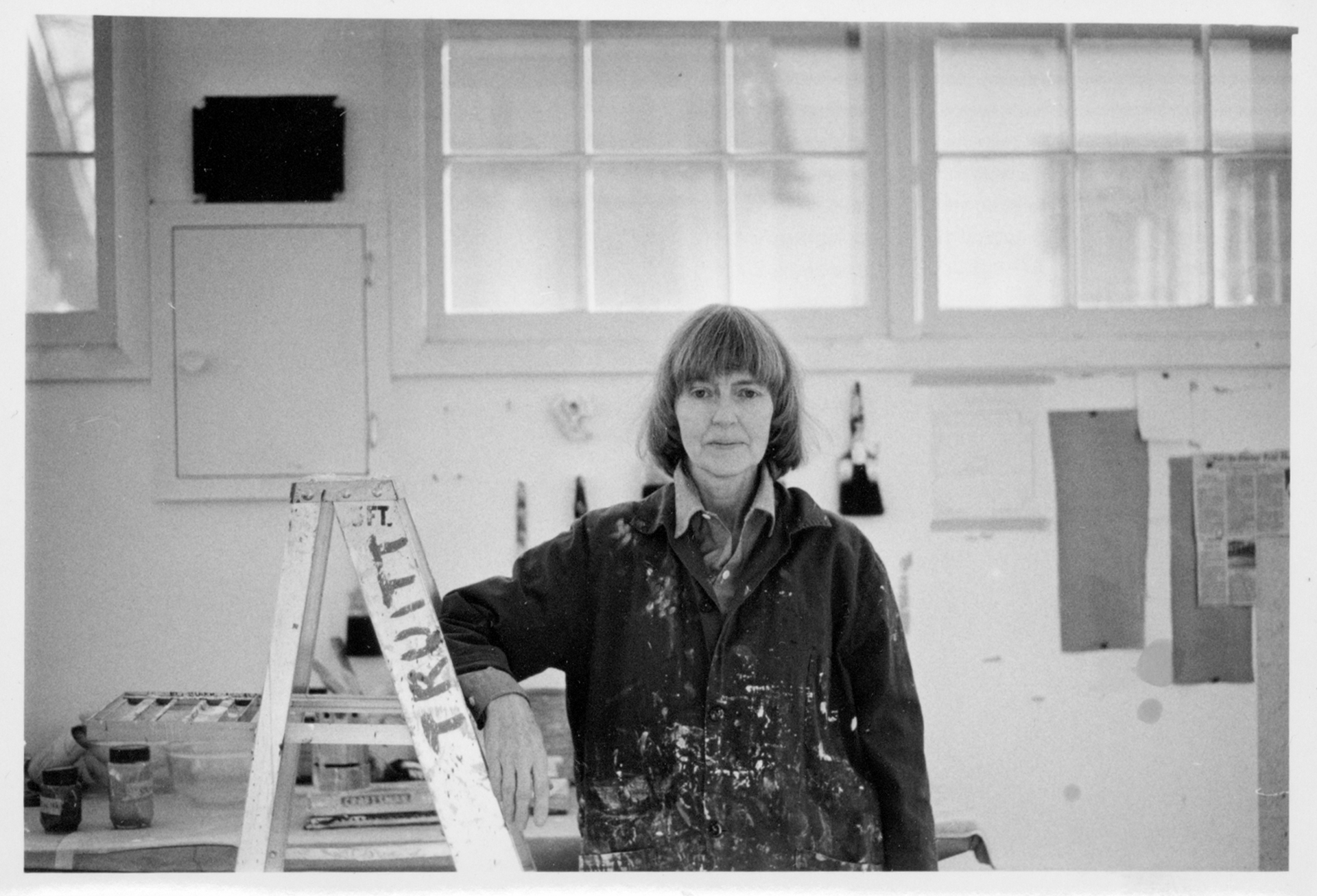
Anne Truitt dans son studio, 1978, photographie noir et blanc
© annetruitt.org. All rights reserved 2026 / Bridgeman Images